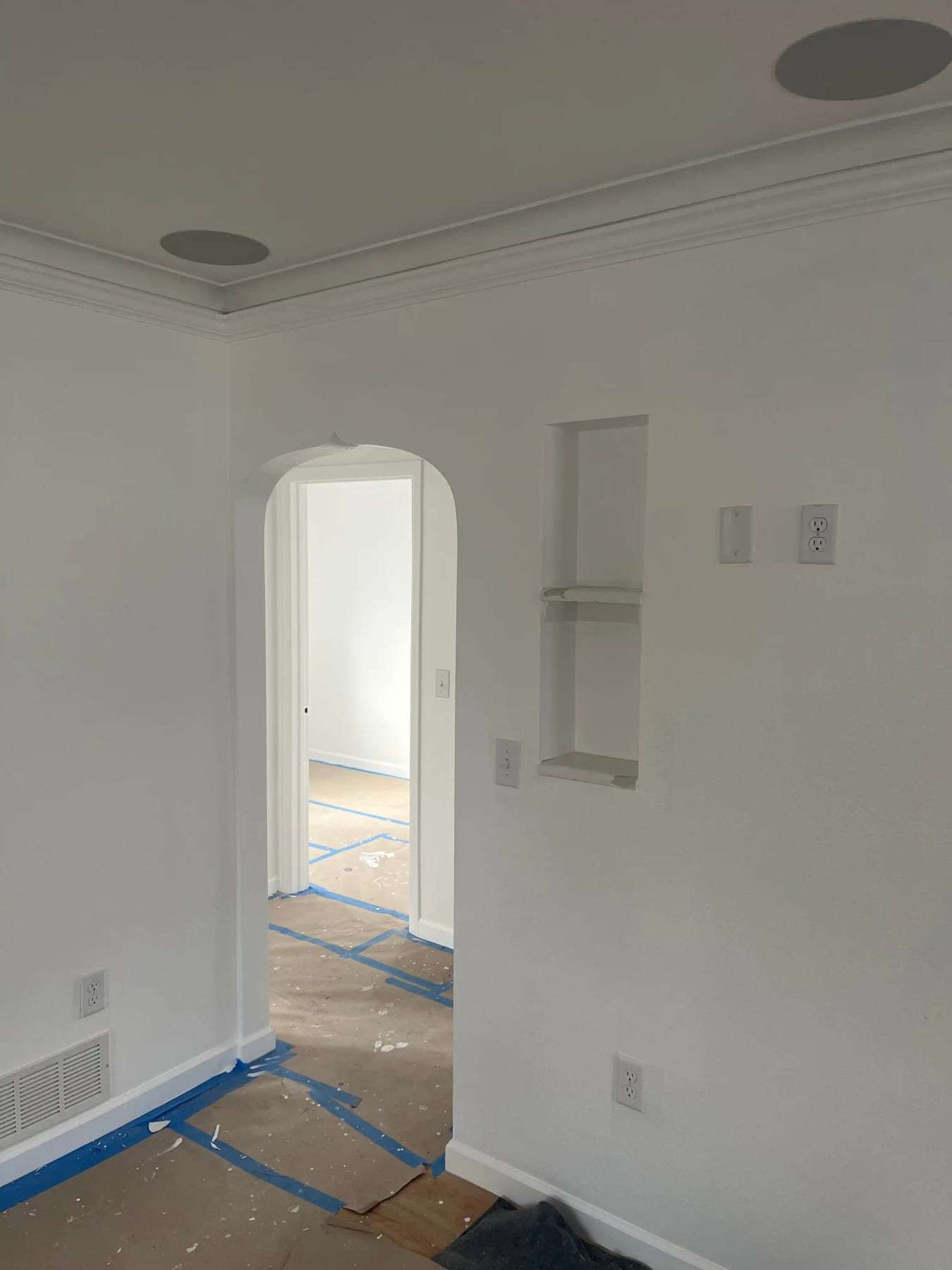
Finished room with an arched doorway and floor protection still down. Illustrative only: this photo is not from a job tied to this site or a specific address.
Why woodwork is its own problem
Walls get washed and painted at turnover, so they get most of the attention. Original woodwork is different: most owners do not want it painted, and many buildings have a mix of stained trim in some rooms and painted trim in others. Smoke film on stained wood shows up as a darker, slightly sticky surface that dulls the grain. Molded profiles, panel edges and the recesses of door casings trap more of it than flat surfaces.
Built-ins add enclosed spaces. A glass-front buffet, a hall linen cabinet or a recessed ironing board cupboard is effectively a closed box that held smoky air for years. Their interiors are often unfinished or finished with an older coating that absorbs odor. When the doors are opened after a long closure, the smell is obvious.
The aim is to remove residue without stripping finish that cannot easily be replaced. That calls for patience, mild cleaners and testing in an inconspicuous spot first.
Finish terms you may hear from a painter or wood restorer
- Shellac
- A traditional finish on much early twentieth-century trim. Alcohol softens it, so cleaners containing alcohol can damage it.
- Varnish
- A tougher film finish common on doors and floors. Generally tolerates mild degreasers better than shellac.
- Amalgamator
- A product that softens and re-flows an old finish to refresh it without full stripping. Used by restorers, not for routine cleaning.
- Shellac-based primer
- A primer often recommended to block odor and stains on surfaces that will be painted.
- Test spot
- A small hidden area, such as the back edge of a door, used to see how a cleaner affects the finish before working on visible areas.
Woodwork items to include in a smoker-unit turnover
- Door faces, both sides, plus the top edge of each door where film collects unseen.
- Door and window casings, including the inside corners of molded profiles.
- Baseboards and quarter round along every wall.
- Built-in buffet interiors, shelves and glass, with doors left open to air out afterward.
- Ironing board cabinets, phone niches and medicine cabinets set into walls.
- Picture rail and plate rail tops, which are rarely cleaned.
- Window sashes and the stops that hold them, especially near where the resident smoked.
General information for Capitol Hill, not a quote or professional advice. In an emergency, call 911.